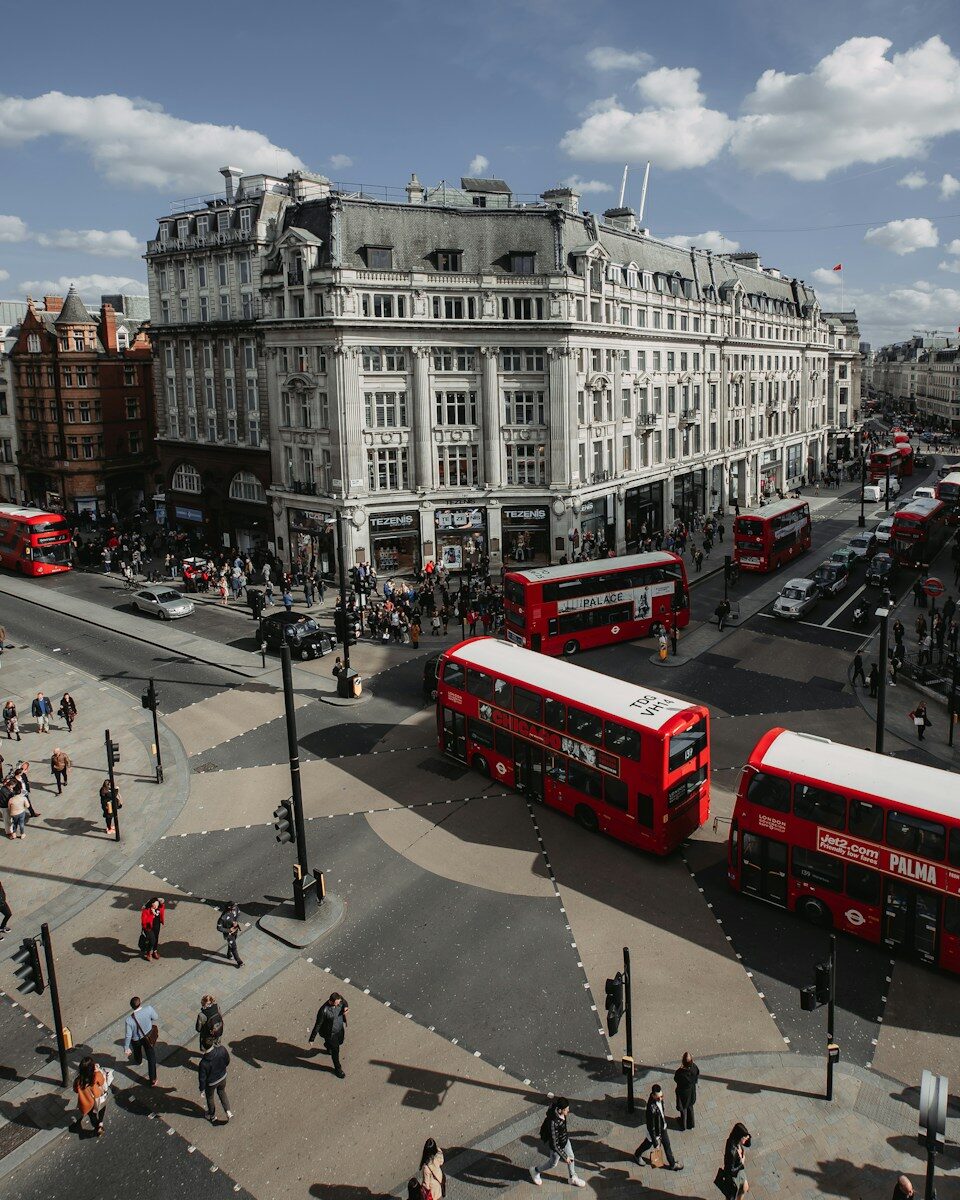
Oxford Street, one of Britain’s busiest and most famous shopping streets, has become traffic-free for the first time following a major pedestrianisation scheme introduced by Mayor of London Sadiq Khan.
From Monday 26 October 2026, almost a kilometre of Oxford Street, between Orchard Street near Selfridges and Great Portland Street, has been closed to cars, buses, taxis, bicycles and other general traffic.
The decision forms part of an estimated £150 million regeneration programme intended to revive the shopping district, attract investment, improve the experience of visitors and strengthen London’s position as an international shopping destination.
But the transformation has also attracted considerable controversy, particularly over its cost, the removal of bus services and the possibility that traffic, pollution and noise will simply move into surrounding residential streets.
The main reason Oxford Street is being pedestrianised is economic regeneration. City Hall believes that removing traffic and turning the street into a more attractive public space will encourage people to visit, spend money and remain in the area for longer.
The project also promises improvements to pedestrian safety, air quality and accessibility.
However, Transport for London’s own assessments acknowledge that some surrounding roads will experience increased traffic and noise, while the removal of direct bus and taxi access could make visiting the street more difficult for some disabled and elderly people.
The traffic restrictions are now in force, although the permanent redesign of the street will continue through 2027.
Why is Oxford Street being pedestrianised?
The central argument behind the scheme is that Oxford Street has become less attractive as a shopping destination, despite remaining one of the most economically important retail areas in Britain.
The street attracts approximately half a million visitors a day and supports an estimated £3.1 billion in annual retail spending.
However, its traditional role as one of London’s premier shopping destinations has come under pressure from changing consumer habits, online shopping, the pandemic and competition from other retail districts.
Several major retailers have closed or reduced their presence over recent years. Department stores that once defined Oxford Street, including Debenhams and House of Fraser, have disappeared from the street.
Their departure was followed by considerable attention surrounding the proliferation of American-style sweet shops, souvenir retailers and other businesses occupying prominent retail premises.
The decline was measurable.
In a June 2025 decision document, City Hall reported that footfall on Oxford Street in November 2024 was 43 per cent below its 2006 level.
By comparison, footfall on Bond Street was just 2 per cent lower than in 2006, while Regent Street was 17 per cent lower.
These figures suggested that Oxford Street had underperformed neighbouring shopping districts over a long period.
There have since been signs of recovery, including the opening of major stores and renewed demand for retail space. But the Mayor’s position is that changing the physical environment will support that recovery and help Oxford Street remain competitive over the longer term.
The proposed approach is to turn the street into a pedestrian destination, with more space for shoppers, places to sit, trees, events, outdoor dining and public squares.
Sadiq Khan has repeatedly compared his ambitions with prominent international public spaces, including New York’s Times Square, Paris’s Champs-Élysées and Barcelona’s La Rambla.
The intention is to make Oxford Street somewhere people deliberately spend time rather than simply walk between shops.
Which part of Oxford Street has been pedestrianised?
The first phase covers approximately 900 metres, extending from Orchard Street in the west to Great Portland Street in the east.
This includes the central shopping area around Selfridges, John Lewis and Oxford Circus.
The closure does not extend along the entire length of Oxford Street.
Sections towards Marble Arch and Tottenham Court Road remain outside the first pedestrianised area, although traffic arrangements on surrounding roads have also changed.
The new restrictions prohibit:
- Private cars and motorcycles
- Buses
- Black taxis and private hire vehicles
- Bicycles and e-bikes
- E-scooters
- Pedicabs
Mobility scooters are permitted, and emergency vehicles retain access at all times.
Essential deliveries, servicing and waste collections can take place between midnight and 7am, subject to the designated access arrangements.
The vehicle restrictions are permanent and operate throughout the week, with the specified exemptions. The physical layout of the pedestrianised area will continue to change as construction progresses.
Transport for London has published updated maps and travel information showing the affected section and alternative bus and taxi arrangements.
Why close Oxford Street to buses and taxis when cars were already restricted?
This is one of the more controversial aspects of the scheme.
Oxford Street was already subject to substantial restrictions on private motor vehicles before October 2026.
On much of the street, ordinary cars and motorcycles were prohibited between 7am and 7pm from Monday to Saturday.
Buses and licensed taxis, however, continued to use the road.
The main change therefore involves removing vehicles that had previously been permitted, particularly buses, taxis and cyclists.
The Mayor’s argument is that even a street largely closed to private cars can remain crowded, noisy and difficult for pedestrians when buses and taxis continue to travel through it.
Removing those vehicles allows the entire road space to be redesigned around walking, public seating and other activities.
It also reduces the number of places where pedestrians and vehicles cross each other’s paths.
But the decision has obvious consequences for people who currently depend on bus and taxi services to reach shops and workplaces directly.
Those concerns have been central to objections from residents, disability organisations and Westminster City Council.
What happens to the buses on Oxford Street?
Several bus routes have been diverted or shortened to accommodate the new pedestrianised area.
According to Transport for London’s updated bus information, the changes began on 24 October, shortly before the pedestrian restrictions came into force.
Routes 7, N7, 94, N113 and N137 now terminate at Marble Arch rather than continuing along their previous routes through the affected area.
Routes 98, 139, 390, N98 and N207 have been redirected onto surrounding roads, including Wigmore Street, Henrietta Place and Cavendish Place.
Other routes have experienced changes to individual stops or connecting arrangements.
The replacement bus stops are generally around 200 metres from the pedestrianised area.
Transport for London says that most affected routes should experience relatively small changes in journey times.
However, its modelling indicated that some journeys on routes 98 and 390 could become several minutes longer because of the diversions.
For passengers who need to change buses or walk further between stops, the practical consequences may be greater than the additional time spent on the vehicle.
TfL has published updated stop information and recommends checking journey arrangements before travelling.
Can taxis still take people to Oxford Street?
Taxis and private hire vehicles can continue to operate on surrounding roads, but they cannot enter the pedestrianised stretch.
Passengers must instead use nearby streets and designated pick-up or drop-off locations.
This has raised particular concerns for people with mobility difficulties who previously relied on taxis to reach individual shops.
For some visitors, an additional walk of 100 or 200 metres may be relatively minor.
For others, particularly people with serious mobility impairments, the same distance may create a substantial practical barrier.
Transport for London acknowledges this issue in its Equality Impact Assessment.
The authority argues that the larger pedestrian area, improved seating, level surfaces and reduced conflict with traffic will provide accessibility benefits once people reach Oxford Street.
However, its assessment also recognises that the changes may disadvantage some older people, disabled visitors and others who depend more heavily on door-to-door transport.
The ultimate accessibility of the new arrangement will therefore depend partly on the quality of surrounding pavements, crossings, bus stops, taxi ranks and resting places.
How much will pedestrianising Oxford Street cost?
The first phase of the Oxford Street pedestrianisation programme has an estimated cost of approximately £150 million.
That figure covers the wider transformation of the street rather than simply the immediate installation of barriers and traffic restrictions.
The programme includes alterations to the road layout, public spaces, planting, street furniture, lighting and the infrastructure required to turn the area into a pedestrian destination.
According to the London Assembly, the first phase is being financed through borrowing.
In a written answer published in May 2026, Sadiq Khan confirmed that the Oxford Street Development Corporation intended to use a combination of public borrowing, private contributions and commercial revenue generation to finance the improvements.
The Mayor said the development corporation was working on sustainable income streams and a commercial strategy.
The public documents available do not establish exactly how much of the total cost will ultimately be met by private contributions or how quickly the borrowing will be repaid.
That distinction matters because the £150 million estimate represents a significant financial commitment to a relatively short section of street.
The wider economic argument is that improvements to an area already generating billions of pounds in spending could justify substantial investment if they attract additional commercial activity.
Whether that happens, and whether the eventual financial benefits justify the costs, will only become clearer after the scheme has been operating for some time.
Will pedestrianising Oxford Street actually improve air quality?
Removing buses, taxis and other vehicles from Oxford Street should reduce traffic-related pollution along the pedestrianised section.
However, the wider environmental consequences are more complicated.
Traffic displaced from Oxford Street will have to use other roads.
That means some neighbouring areas could experience increased vehicle movements, greater noise and changes in local air pollution.
These effects were examined in Transport for London’s modelling, published alongside the Mayor’s February 2026 decision to approve the scheme.
The assessment considered nitrogen dioxide, particulate matter, carbon dioxide emissions and road traffic noise across the surrounding area.
Of 85 locations assessed for air quality, the modelling forecast improvements in nitrogen dioxide at several locations, including four within the pedestrianisation area.
But it also forecast small increases in nitrogen dioxide concentrations at numerous locations elsewhere in the study area.
The overall carbon dioxide reduction attributable to the pedestrianisation proposals themselves was estimated at approximately 431 tonnes annually, equivalent to around 2 per cent of the modelled road traffic emissions.
That is a modest change compared with the larger reductions forecast from improvements in vehicle technology and the wider vehicle fleet.
The noise assessment presented an equally mixed picture.
It forecast substantial reductions in traffic noise on Oxford Street itself, while some surrounding streets could experience increases.
For residents of those neighbouring streets, this is among the most significant concerns about the project.
Improving conditions on Oxford Street will provide a visible benefit to shoppers, but it remains important to establish whether environmental problems have been reduced overall or redistributed elsewhere.
Transport for London has committed to monitoring the road network following implementation.
The eventual measured impact may differ from the modelling.
Why is Westminster City Council opposed to the plans?
Westminster City Council has expressed longstanding concerns about the pedestrianisation of Oxford Street.
Its objections have focused on the possible effects on surrounding neighbourhoods, public transport, accessibility and the wider road network.
The council has also questioned whether the Mayor’s approach provides sufficient local accountability.
Earlier proposals for pedestrianisation failed partly because Westminster withdrew its support in 2018.
When the plans were revived, Sadiq Khan pursued a different governance arrangement.
In January 2026, the Oxford Street Development Corporation was established as a mayoral development corporation, giving City Hall a dedicated organisation to coordinate regeneration.
Transport and highway authority responsibilities for the relevant roads were also transferred to Transport for London.
This allowed the Mayor to advance plans that had previously encountered resistance from the local council.
In August 2026, Westminster called for a full Environmental Impact Assessment, arguing that the consequences for traffic, air quality, noise and public safety required further scrutiny.
The council questioned the decision to proceed without the additional assessment it was seeking.
It also argued that the proposed timetable was too rapid and that insufficient detail had been provided about mitigating problems on surrounding streets.
City Hall and Transport for London maintain that the required impact assessments and consultation processes were undertaken and that the benefits of the scheme justify proceeding.
The disagreement is therefore partly about the desirability of pedestrianisation and partly about the process used to implement it.
Do Londoners actually support pedestrianising Oxford Street?
The public consultation conducted in early 2025 found majority support among respondents.
According to the Greater London Authority, 66 per cent of those who responded to the question about the principle of pedestrianisation supported it.
A separate question concerning the establishment of a mayoral development corporation received 69 per cent support.
The consultation received 6,642 written responses overall.
These findings were cited by the Mayor when approving further development of the scheme.
However, consultation responses are not equivalent to a representative opinion poll of Londoners.
People who choose to respond may have particularly strong views, and the results cannot automatically be generalised to every resident, business or visitor.
The later Transport for London consultation also recorded substantial concerns about congestion, the accessibility of buses and taxis, and difficulties for older and disabled people.
The evidence therefore shows both significant support for the broad principle and opposition to aspects of its implementation.
Many of the concerns relate to whether the pedestrianised area will function successfully alongside the existing transport network.
Will Oxford Street become safer for pedestrians?
Transport for London expects the removal of vehicles to reduce the risk of collisions between road users and pedestrians.
The existing street accommodates very high numbers of visitors, particularly during weekends and the Christmas shopping period.
By removing buses, taxis, bicycles and other vehicles, the scheme eliminates many of the potential conflicts associated with crossing or walking beside moving traffic.
The authority’s Equality Impact Assessment also identifies possible benefits for children, older people and those who find crowded, traffic-heavy environments difficult to navigate.
The changes will create a larger area in which people can walk without needing to remain on the existing pavements.
However, the new public spaces will still require effective management.
Emergency access, crowd control, maintenance, security, waste collections and access from side streets all remain necessary.
The presence of a pedestrianised zone does not automatically remove every safety concern associated with such a busy destination.
The scheme’s effectiveness will depend on both the physical design and its ongoing operation.
What will the new Oxford Street look like?
The closure to traffic on 26 October marks the first stage of a much larger physical transformation.
The Oxford Street Development Corporation has confirmed that the initial changes will be relatively limited to avoid excessive disruption during the Christmas shopping period.
The more substantial improvements are expected to follow during 2027.
Plans include:
- More than 50 new trees
- Over 100 new seats
- Two public squares
- New lighting and signage
- Additional resting places and dining areas
- More space for cultural activities, events and outdoor entertainment
The development corporation expects a more developed transitional public-space scheme to be in place by the end of spring 2027.
The initial design is intended to allow officials to collect feedback from visitors, businesses, residents and accessibility organisations before finalising the permanent layout.
That means some of the street’s eventual appearance and detailed features may still change.
The traffic restrictions themselves are intended to remain permanent.
Is the whole of Oxford Street eventually going to close to cars?
The Mayor’s wider ambition extends beyond the first section between Orchard Street and Great Portland Street.
The long-term strategy is to create a pedestrian-focused shopping destination along more of Oxford Street.
However, the remaining sections have not been given the same confirmed implementation timetable.
Future phases will require further planning, consultation and consideration of transport arrangements.
The current closure is therefore the beginning of a wider transformation rather than the completion of the entire programme.
The success of the first phase, including its effects on congestion, accessibility and commercial activity, is likely to influence the design and progression of later stages.
For now, only the first section has become permanently traffic-free.
Will shops on Oxford Street remain open during the works?
Yes. The pedestrianisation programme is intended to allow shops, restaurants and other businesses to continue operating.
The initial changes have been timed to minimise disruption during the Christmas shopping period, one of the busiest parts of the year for Oxford Street retailers.
Construction work will continue, but the development corporation says it intends to keep disruption limited in the immediate weeks following the closure.
Businesses will also be able to receive deliveries and servicing overnight, between midnight and 7am.
The removal of daytime vehicle access means some businesses will need to change existing delivery arrangements.
Shoppers can continue visiting the area through the surrounding transport network.
Bond Street, Oxford Circus and Tottenham Court Road stations provide access to the main shopping area, with Marble Arch serving the western end.
The Elizabeth line has also improved connections to Bond Street and Tottenham Court Road, allowing visitors to reach the West End from a wider area without travelling by road.
Will Oxford Street pedestrianisation be worth £150 million?
The financial and economic case is based on the expectation that a more attractive street will generate additional visits, retail spending, private investment and employment.
There is some evidence to support the general principle that pedestrian-friendly retail environments can attract customers and create opportunities for businesses.
However, the outcome for Oxford Street cannot yet be established.
The street already generates billions of pounds in annual spending, and its more recent recovery has been supported by factors including changing retail demand, major new shops and improved transport connections.
It will therefore be difficult to attribute every future improvement directly to pedestrianisation.
There are also costs beyond the construction budget, including traffic management, maintenance and the effects on nearby roads.
The project can be assessed against measurable outcomes over time, including visitor numbers, retail performance, business occupancy, journey times, accessibility and environmental conditions.
One particularly important test will be whether Oxford Street becomes more successful without imposing excessive costs or inconvenience on surrounding neighbourhoods.
The removal of vehicles has already happened. The claimed economic benefits are still to be demonstrated.
So why are they pedestrianising Oxford Street?
Oxford Street is being pedestrianised primarily to strengthen its future as a major shopping, business and visitor destination.
The Mayor of London believes that removing vehicles, creating public spaces and improving the environment will help attract shoppers and investment while making the street safer and more pleasant.
The project also responds to concerns about Oxford Street’s long-term performance, including the decline in footfall recorded over previous decades and changes in the retail industry.
As of 26 October 2026, the first major section is officially traffic-free.
But the financial, transport and environmental consequences remain subjects of debate.
The £150 million programme represents a substantial investment in one of Britain’s most economically significant streets, and the physical transformation will continue into 2027.
For shoppers, the immediate result is a larger traffic-free area around some of London’s best-known stores.
For bus passengers, taxi users, businesses and nearby residents, the changes will require adjustments that may prove more consequential.
The real measure of success will be whether pedestrianisation creates a better Oxford Street while also functioning effectively for the people who live, work and travel around it.
Sources
- Oxford Street Development Corporation: Oxford Street Goes Traffic Free, 26 October 2026. Official confirmation of the closure, street improvements, delivery arrangements and programme timetable.
- Transport for London: Oxford Street Area Works. Current traffic restrictions, revised bus routes, cycling rules and travel information.
- Mayor of London: Decision MD3475, Traffic and Highway Changes to Enable Oxford Street Pedestrianisation, 26 February 2026. Traffic modelling, environmental assessments, accessibility implications and consultation responses.
- Mayor of London: Decision MD3394, Oxford Street Development Corporation, June 2025. Economic justification, historical footfall figures and consultation results.
- London Assembly: How Will Oxford Street Development Deliver for London’s Economy?, 18 March 2026. Project funding and economic scrutiny.
- Mayor of London: Oxford Street West Funding and Borrowing, 27 May 2026. Funding strategy involving public borrowing and potential private contributions.
- Westminster City Council: Council Demands Full Environmental Impact Assessment, 28 August 2026. Council objections concerning pollution, traffic and the assessment process.
- Transport for London: Oxford Street Consultation. Consultation material, accessibility assessments and proposed transport changes.
- Reuters: Buses Out, Shoppers In: London’s Oxford Street Goes Traffic-Free, 26 October 2026. Coverage of the introduction of pedestrianisation.
- Oxford Street Development Corporation: Frequently Asked Questions. Information about the wider transformation and future phases.