How the explosion in e-commerce logistics is pushing giant distribution sheds onto protected land across England, pitting residents against developers, councils against communities, and planning policy against itself
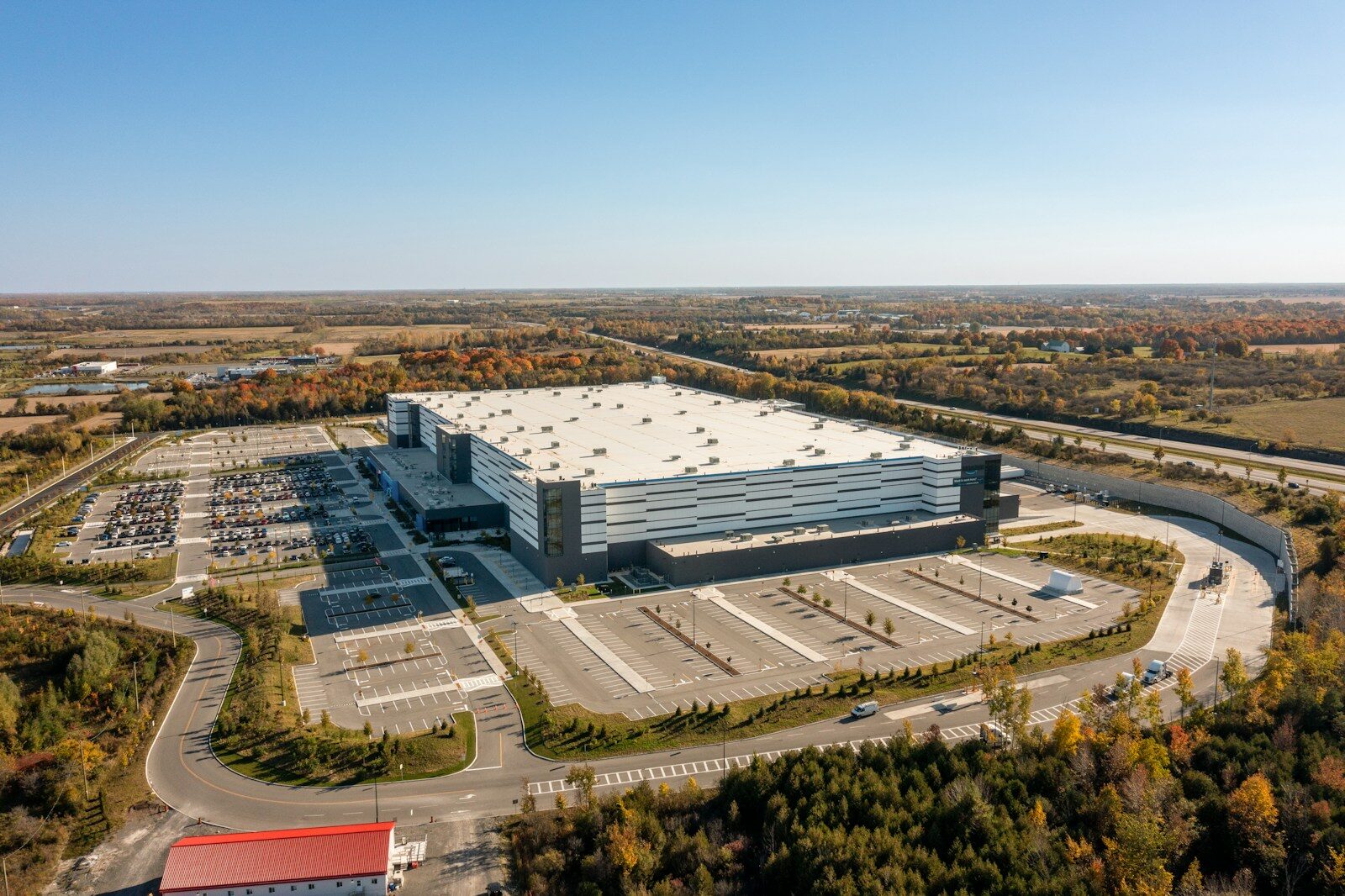
The four warehouses rising above the rooftops of Tyldesley in Greater Manchester are 18 metres tall — around the height of a six-storey building. They sit within 30 metres of the back gardens of residential homes. A footpath used by children to reach Garrett Hall Primary School runs alongside the site. Last autumn, the path flooded. Parents filmed themselves wading through water to get their children to class.
The site is called Astley Business Park. Plans submitted by logistics company PLP were approved by Wigan’s planning committee in June 2024. The development covers 350,000 square feet. The independent audit commissioned by Wigan Council in response to residents’ complaints concluded that consultation with local residents had been “wholly inadequate.” The council maintains that planning permission was granted in line with national legislation.
Astley is not an isolated case. It is one flashpoint in a much larger story playing out across Britain, as the logistics industry scrambles for land and green belt designations — long treated as near-inviolable — find themselves under sustained, structural pressure.
The demand behind the sheds
The pressure has a straightforward origin. E-commerce now accounts for approximately 27% of total UK retail sales, and the industry has moved beyond the emergency capacity phase of the pandemic years into a period of stabilised, high-specification growth. Consumers have come to expect next-day or same-day delivery as standard, and the entire logistics chain has to be engineered around that expectation.
Industrial investment reached £8.2 billion in 2024, with overseas funds behind 60% of capital deployed. SEGRO alone committed £400 million in 2024 and earmarked £2.0 billion for 2025–2027 development pipelines. Average industrial land prices have climbed sharply as a result, with capacity constraints in the most sought-after areas pushing rents higher and forcing operators to look further afield for viable sites.
The geography of the boom is concentrated. The “Golden Triangle” in the Midlands remains the UK’s logistics heartland, thanks to its prime location for national distribution, with regions like Northamptonshire and Leicestershire seeing massive investment in new, large-scale warehouse infrastructure. But as prime locations fill up, the search for land pushes outward — onto the urban fringes, and increasingly onto land that sits within or borders green belt designations.
What the green belt is — and isn’t
Before examining the planning battles, it is worth being precise about what the green belt actually is. The policy is widely understood as an environmental measure, but that is not what it was designed for. The fundamental aim of green belt policy is still to “prevent urban sprawl by keeping land permanently open”; the essential characteristics of green belts are their openness and their permanence. Environmental protection is not among its five statutory purposes.
This distinction matters, because it shapes how planning decisions are made. Around 76% of London’s Metropolitan Green Belt is used for agricultural purposes, golf courses, and hospitals, with just 22% dedicated to environmental protection or publicly accessible parks. Large portions of green belt land across England are simply farmland or semi-managed countryside — open, but not necessarily ecologically significant in their own right.
England’s green belt currently covers 1,633,220 hectares, around 12.5% of the land area of England. The South East has the largest area at 304,250 hectares, followed by the West Midlands with 264,500 hectares and Yorkshire and The Humber with 260,470 hectares.
Planning under pressure
Under planning rules, development on green belt land is only permitted in “very special circumstances” — a high bar that is supposed to limit approvals to genuinely exceptional cases. In practice, the test has become a negotiation, with job creation and economic need frequently cited as the circumstances that override green belt harm.
The case of Bold, near St Helens, illustrates the tension. The Omega West development — a major logistics hub including warehousing for discount retailer Home Bargains — was approved on green belt land east of Liverpool despite the planning inspector’s own findings being stark. The inspector wrote that “it is not disputed that the proposed development would cause significant harm to the openness of the Green Belt. The site is open countryside.” But the prospect of jobs in a deprived area was sufficient to override the loss of nature. The development will see the destruction of 18 acres of established woodland.
Not every such application succeeds. In South Warrington, a £300 million logistics park known as Six56 — which would have provided approximately 3.1 million square feet of new warehousing and distribution space adjacent to junction 20 of the M6 and junction 9 of the M56 — was rejected by the Secretary of State in late 2024. The planning inspector found that the development would have caused substantial damage to the openness of the Green Belt, with significant adverse effects from 24-hour traffic movements, lighting, and general site operations, and that there were no “Very Special Circumstances” sufficient to outweigh the harm.
The developer, Langtree, said the decision appeared to “fly in the face of the government’s stated growth ambitions.”
Grey belt: the new frontier
The government’s December 2024 reforms to the National Planning Policy Framework (NPPF) introduced a concept that is reshaping the debate: the grey belt. Grey belt is defined as land in the green belt comprising previously developed land and/or any other land that does not strongly contribute to any of three of the Green Belt’s five purposes — preventing the unrestricted sprawl of large built-up areas, preventing neighbouring towns from merging, and preserving the setting and special character of historic towns.
Examples of land likely to attract grey belt designation include quarries, car parks, golf courses, glasshouses, solar parks, caravan parks, campsites, and other leisure facilities. In theory, this targets genuinely underperforming land rather than functioning green belt. In practice, critics argue the definition is broad enough to encompass almost anything.
A parliamentary petition calling on the government to narrow the grey belt definition attracted more than 42,000 signatures, arguing that the definition is so broad it could include almost any green belt land and urging the government to ensure that grey belt proposals are judged against all five green belt purposes consistently.
The government’s position is that the changes are targeted and balanced. Officials have argued that the government is committed to preserving green belts which have served England’s towns and cities well over many decades, not least in terms of checking the unrestricted sprawl of large built-up areas. Under the new NPPF, local planning authorities are now required to review green belt boundaries where they cannot meet their housing, commercial, or other needs without adjusting those boundaries — a significant change from the previous system, where such reviews were optional.
The House of Lords Built Environment Committee has been sceptical about the overall effect. Its inquiry concluded that the grey belt policy is unlikely to make any significant difference to the number of new homes that can be built. Whether the same is true for commercial and logistics development remains to be seen.
What residents are left with
Back in Tyldesley, the consequences of a planning decision made in a council chamber in 2024 are visible in back gardens and on school routes. The Astley and Mosley Common Warehouses Action Group (AWAG) has charged that the flooding in residents’ gardens was predictable, noting that the engineer’s drainage design report from November 2024 had deemed soakaway drainage unsuitable because of “clay material encountered throughout the development site.” The solution installed — a gravel-filled soakaway — failed almost immediately.
In a reflection of how far some residents have been pushed, the Astley Business Park Residents group wrote to the King, and received a reply from Buckingham Palace. The letter acknowledged that His Majesty has worked for over 50 years to protect and restore nature, while noting that he acts on the advice of his ministers.
It is, in its way, an accurate summary of how the planning system works. Residents can campaign, petition, march, and write to royalty. But the decisions about what gets built, and where, are made through a framework that treats commercial need, employment, and economic growth as legitimate counterweights to landscape and community objection. Whether that balance is set correctly is the question that warehouse developments across Britain are forcing into the open.